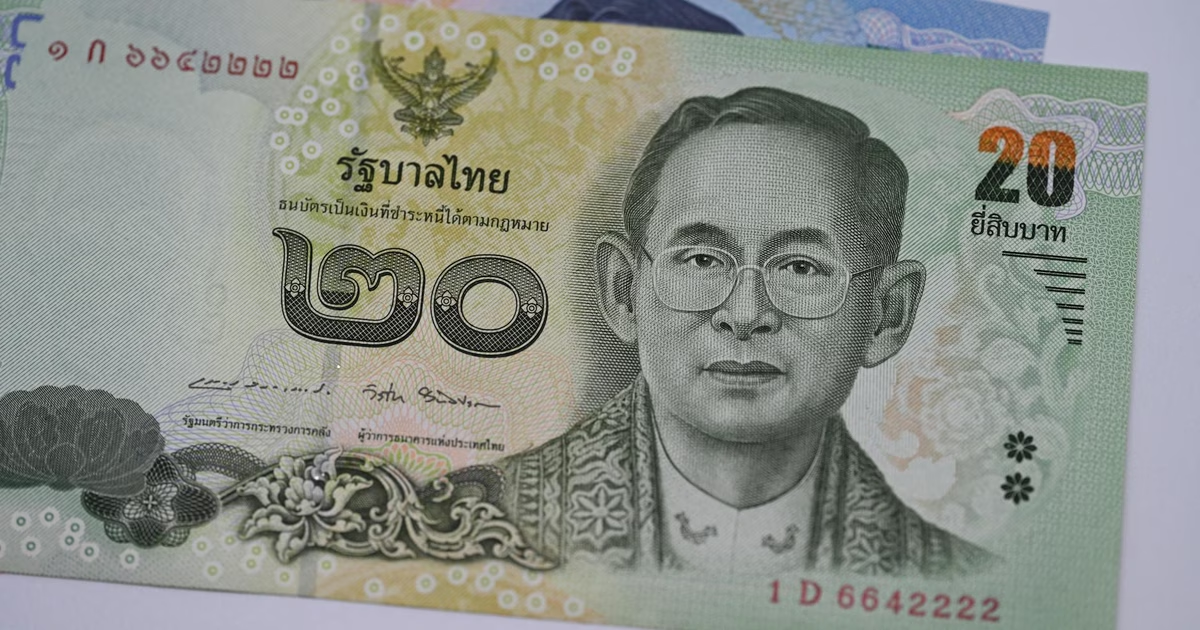

Thailand's banks froze over 400,000 accounts in 2023–2024 as part of a crackdown on online fraud and money mule networks. Many of those accounts belonged to ordinary expats, small business owners, and long-term residents with no connection to fraud. The freezes were automated, triggered by transaction pattern analysis, and reversing them required in-person visits, Thai legal representation, and months of waiting. For most expats, the risk-utility math on Thai bank accounts no longer works.
What triggered Thailand's mass account freezes?
Thailand's Department of Special Investigation (DSI) partnered with the Bank of Thailand and commercial banks to implement automated fraud detection targeting accounts used for money laundering and call center scam operations. The system flags accounts based on transaction patterns — multiple incoming transfers from different sources, cash-heavy activity, and rapid movement of funds are all triggers.
The problem: these patterns describe legitimate expat banking behavior. Receiving income from multiple international clients, exchanging currency, moving money between accounts for rent and living expenses — all of this looks identical to fraud patterns in an automated system that was trained on Thai domestic account behavior.
What are the better alternatives for expats in Thailand?
Wise (formerly TransferWise) is the most practical solution for most expats. You can hold Thai baht in a Wise account, receive international transfers, and make local payments using a Wise debit card. Transactions are processed through Wise's local bank partnerships without the compliance exposure of a personal Thai account. Local ATM withdrawals via Wise work at most Thai ATMs.
Revolut and Airwallex are also strong options. For SaaS founders, Mercury handles your USD operations; Wise handles the THB conversion and local spending. There's no compelling reason to have a traditional Thai bank account when these alternatives exist.
When might a Thai bank account still make sense?
There are specific cases where a Thai account is practically required: long-term visa applications (the Thailand Elite and LTR visa processes ask for bank statements showing sufficient funds), large real estate purchases, or local business operations with Thai employees and suppliers. For the LTR visa, showing a Wise or foreign account balance with Thai baht equivalents is sometimes accepted, but not always.
If you do need a Thai account, Bangkok Bank and Kasikorn Bank (KBank) are the most foreigner-friendly. Open the account in person with a non-immigrant visa, keep activity simple (regular monthly deposits, few payees), and maintain low average balances to stay below automated fraud thresholds.
What are the practical consequences of a frozen account?
When a Thai bank account is frozen by DSI order, you lose access to all funds immediately. The bank cannot unfreeze it without a DSI order — not even the branch manager can override this. You must hire a Thai attorney, appear in person at the DSI office, provide documentation establishing the legitimate source of funds, and wait for case processing. The average resolution takes 3–9 months. During this time your funds are completely inaccessible.
For expats who kept their primary emergency funds in a Thai account, this is catastrophic. For someone using it as a minor convenience account for local spending while keeping real money offshore, it's an inconvenience. The lesson: never keep meaningful money in a Thai bank account as your primary financial hub.
Verdict
Don't open a Thai bank account unless you have a specific, necessary reason — visa documentation, local business operations — and keep balances minimal if you do. For everyday living expenses in Thailand, Wise is safer, more convenient, and doesn't expose you to the DSI's automated fraud detection. Your real banking infrastructure should be offshore or with a provider like Mercury that operates outside Thai jurisdiction entirely.
Frequently Asked Questions
Can a frozen Thai bank account affect my visa status?
Indirectly, yes. If your visa extension requires proof of sufficient funds in a Thai bank account and that account is frozen, you could have difficulty demonstrating financial sufficiency at renewal time. This is one reason to maintain alternative documentation of financial standing.
Does the crackdown affect corporate accounts?
Corporate accounts are subject to the same automated monitoring but are somewhat less commonly flagged than personal accounts — Thai companies with regular payroll and supplier payments have transaction patterns that look more like legitimate businesses. Still, keep corporate accounts simple and document all incoming transfers.
Can I use a Thai bank account with Stripe or other payment processors?
No. Stripe does not support Thai baht accounts for payouts in most cases, and payment processors generally require your business bank account to match your entity's country of registration. A Thai personal account is not a substitute for a US business account for international payment processing.
Is Wise fully legal for use in Thailand?
Yes. Wise operates legally in Thailand and is authorized by the Bank of Thailand. Using Wise for currency exchange and local spending is compliant and does not raise the same compliance flags as moving money through a local personal bank account.