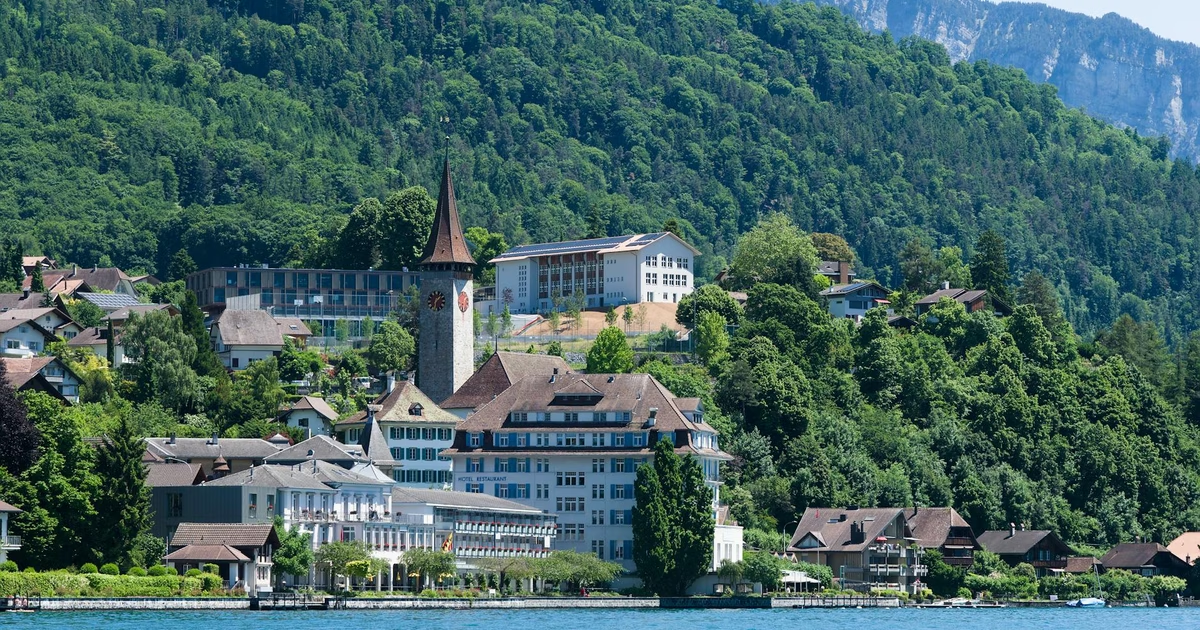

The Misconception About Swiss Banking
Swiss banking has a reputation problem — or rather, two of them. One camp thinks it's exclusively for billionaires. The other assumes FATCA and the OECD's Common Reporting Standard killed Swiss privacy entirely. Neither is accurate. Swiss banks remain among the most robustly regulated, well-capitalized, and operationally secure financial institutions in the world, and they remain accessible to non-US founders who establish the right residency structure.
What Swiss Banking Actually Offers
The practical case for Swiss banking in 2025 is not about secrecy — that era ended. It's about the following:
- Asset segregation: Holding assets in a jurisdiction with no exposure to your home country's banking system insulates you from domestic banking crises, deposit freezes, and capital controls.
- Political stability: Switzerland has maintained banking continuity through two world wars and every global financial crisis of the modern era. The institutional track record is unmatched.
- Multi-currency accounts: Swiss private banks routinely hold USD, EUR, CHF, GBP, and other currencies in a single account with competitive FX management.
- Wealth management depth: For founders with liquidity events or complex asset structures, Swiss private banks offer sophisticated custody, trust, and family office services that most domestic institutions can't match.
- Counterparty quality: Swiss banks are among the most well-capitalized in the world. The contrast with regional US or Canadian banks — especially post-SVB — is significant.
The US Citizen Problem
US citizens face a specific obstacle: FATCA compliance requirements make most Swiss private banks unwilling to onboard American clients. The compliance cost is too high relative to the relationship size for most accounts below $1–2M. This is not illegal or improper — it's rational risk management on the bank's part. For US citizens, the path to Swiss banking typically runs through a Swiss subsidiary of a global custodian or through specialized intermediaries.
For non-US nationals — particularly those holding residency in a favorable jurisdiction like Paraguay, Panama, or the UAE — Swiss private banking is genuinely accessible and the onboarding process, while thorough, is not prohibitive.
How Residency Unlocks the Door
Swiss banks don't require Swiss residency. They do require residency somewhere credible with proper documentation: proof of address, source of funds documentation, and compliance with the bank's CDD (Customer Due Diligence) requirements. Founders who have established residency in a clean, FATF-compliant jurisdiction — Paraguay and Panama are both solid — generally satisfy these requirements without significant friction.
Which Banks Are Worth Considering
Julius Baer, Pictet, Lombard Odier, and UBS private banking are the tier-one names. For founders with accounts in the $500K–$5M range, cantonal banks and smaller private institutions often provide more attentive service and lower minimums than the global names. The right institution depends on asset size, currency needs, and whether you want active management or pure custody.
The Security Case Is Simple
Every founder who has built meaningful wealth in a single domestic banking system is running a concentration risk they often don't acknowledge. Your domestic bank is subject to your government's policy whims, domestic economic conditions, and the bank's own solvency. A Swiss account doesn't replace your domestic banking — it diversifies it. For security-oriented founders, that diversification is not paranoia. It's prudent financial architecture.
This post is for informational purposes only and does not constitute financial or legal advice. Banking regulations and access vary by jurisdiction and individual circumstances.